Program Restructuring
Introduction
Almost every learning designer or trainer has encountered a version of such legacy training program. On paper, it was an intensive, three-week onboarding experience designed to get new hires up to speed. In reality, it was a gauntlet of back-to-back presentations—an endurance test of "death by PowerPoint."
Problem Statement
Our three-week training program Clinical and Product Foundations was basically a long series of presentations. It lacked a central plan and relied on a rotating team of trainers. Trainers knew which presentations had been covered, but they did not know which activities were actually done or how well the participants understood the content.
Furthermore, the topics did not follow a logical sequence. Some advanced topics required foundational knowledge that had not been taught yet. Because this was not considered when scheduling, learners struggled to keep up.
This created major issues for the learners:
Redundancy: Learners repeated the same content and activities across different days.
Gaps: Vital concepts were missed because trainers assumed someone else taught them.
The program was just a collection of slides, not a journey. We needed to stop focusing on presentations and rebuild the program.
Solution
We used our three-day on-site team meeting to work on these issues. I ran workshops with the trainers and program managers to restructure the entire clinical and product program. Together, we built a new training framework and stored it in our shared folder so everyone had full visibility.
Here is the step-by-step process we used to rebuild the training:
Step 1: Set the Main Program Goals
We started by looking at the big picture. We paused the daily schedule to identify the main goals of the entire Clinical and Product Foundations program.
Instead of asking what content we wanted to show, we asked what results the business needed to see. We defined the top milestones every learner had to reach after completing the program and before the next part of the whole onboarding process. This gave us a clear target and ensured every future decision aligned with real performance outcomes.
Step 2: Map Out the Topics
Next, we mapped out the essential topics learners needed to master to reach those main goals.
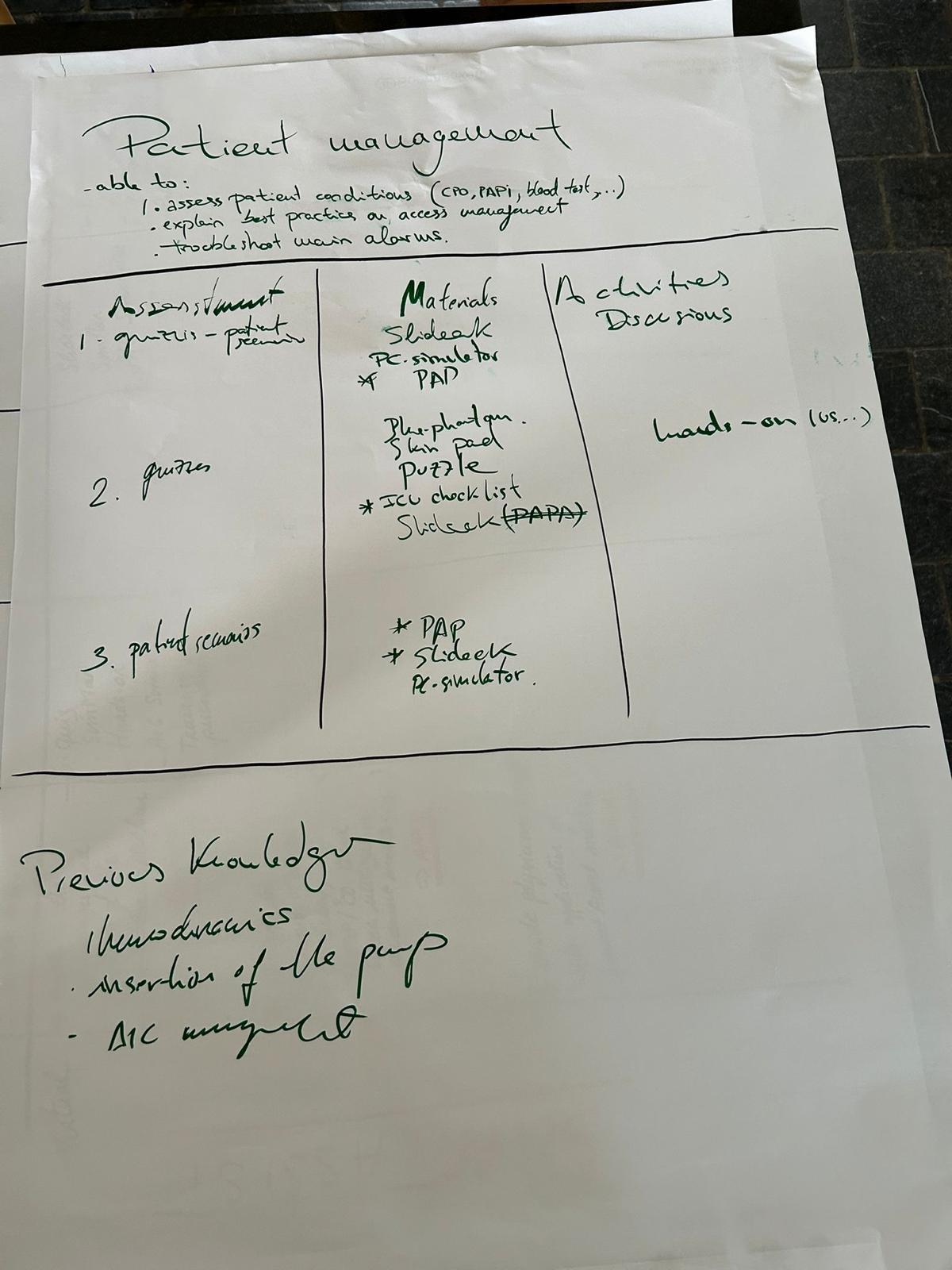
Prerequisites: To fix the logical gaps, we identified exactly what previous knowledge learners needed for each area. This allowed us to sequence the topics correctly, ensuring learners built their skills step-by-step and always had the required foundational knowledge before moving to advanced concepts.
Learning actions: We described what learners must be able to do after completing the topic. To write these clearly, the team used Bloom’s Taxonomy—a framework that classifies learning behaviors into levels of complexity. Instead of vague goals like "understand the system," the framework helped select precise action verbs (such as identify, troubleshoot, or design). This matched each topic to the level of thinking required for the job.
Measurement: Clear criteria define how to test if learners reached the goal. Because the expected actions used precise verbs, the evaluation became straightforward. If the objective required a learner to troubleshoot, the test measured that specific skill rather than relying on a simple multiple-choice quiz.
Materials and activities: Specific activities and resources support each topic. The training still uses many of the existing presentations for foundational knowledge, but the materials now expand into active learning and toolkit includes hands-on training, interactive practice, and work with physical products.
Step 3: Implement
We launched the restructured program inside our shared folder to ensure complete transparency. This folder acts as a central hub for the entire training schedule.
Now, before starting any session, trainers can quickly check-in and see what previous knowledge was taught, which activities were completed, and how well the participants understood the content. This shared visibility eliminates the risk of missing concepts or repeating activities.
Conclusion
By shifting our focus from what we teach to what they learn, we transformed the program. We replaced a fragmented calendar of presentations with a structured, logical journey stored in our shared folder. Now, our trainers are aligned, our learners have a clear path without gaps or repeats, and we can actually measure the success of our training.