Train the Trainer
Introduction
One of the absolute best parts of my work as a learning expert is collaborating with educators and trainers, supporting them in delivering sessions where learners don’t just sit, listen, and read. My goal is to help them curate meaningful learning experiences—environments where participants leave the room understanding what they learned and how to apply it.
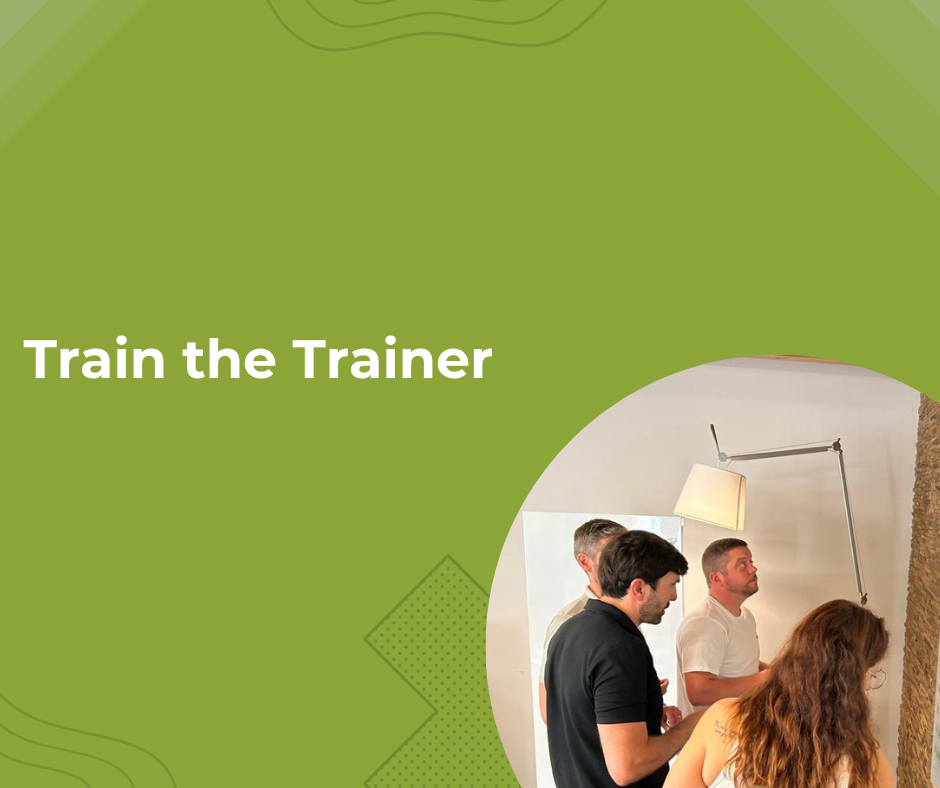
This post describes a series of Train-the-Trainer sessions I recently facilitated with an amazing group of clinical and product trainers. These workshops equipped the team with both foundational adult learning knowledge and immediate, practical applications.
The result? The NPS for the training programs these trainers facilitate increased by 28 points!!
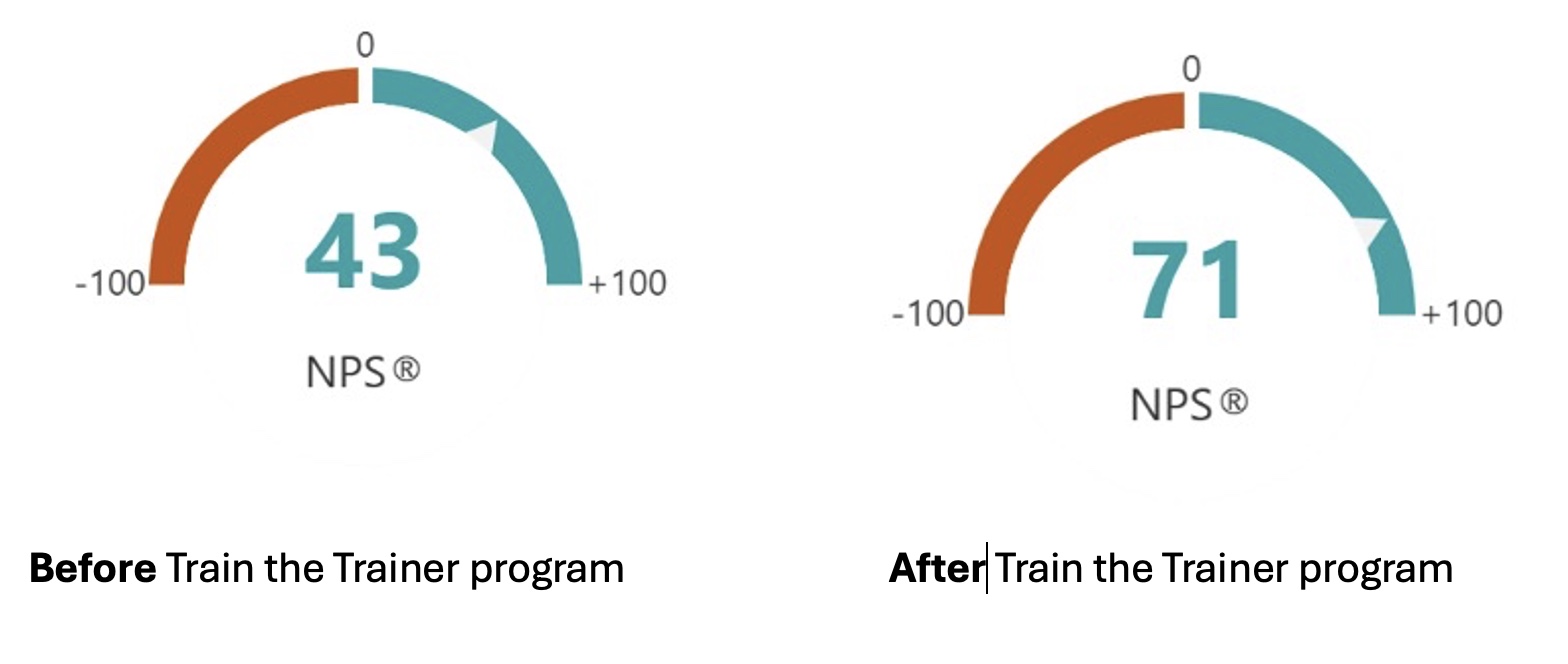
Problem Statement
When I first joined the team, my onboarding included going through our product and clinical training programs. I approached this phase wearing two hats: while I was learning the foundational content, I was also observing the sessions from a Learning Experience perspective.
Alongside my own observations of how the content was delivered, I dug into historical learner feedback to see what was working and where participants were getting stuck. The data was clear. Our trainers possessed incredible, deep subject matter expertise, but they needed stronger pedagogical tools to translate that complex knowledge into engaging, learner-centric experiences.
Solution
Based on these insights, I designed a Train-the-Trainer initiative tailored to their needs. I presented the strategy, data, and curriculum to our stakeholders and got immediate buy-in. Two weeks later, we were ready to launch.
The curriculum
8 sessions across 2 quarters
Topic 1: Introduction to Adult Learning Theories
First things first: How does learning even happen?
We started by looking at what actually makes adults want to learn. We talked about what our participants need from the training, how they process new information, and what keeps them interested.
To make sense of it all, we shared our own experiences as learners. We talked about the classes and workshops we’ve taken in the past and what we actually remembered from the sessions where we had to learn something tough.
Unsurprisingly, nobody remembered the long slide decks or the passive lectures but the moments they had to solve a real problem, or when the trainer/instructor treated them like peers.
From there, we focused on the how and why of adult learning.
Relevance matters: Adults learn better if it helps them solve a current problem or do their job better.
Use their experience: They don't arrive as blank slates; you need to connect new info to what they already know.
Action over listening: All learners learn better by combining doing, applying, restructuring, synthesising, collaborating, and practicing, not by sitting through long lectures.
Keep it simple: The brain can only hold so much at once; cut out the extra facts to avoid overloading them.
Topic 2: The Training Cycle
Next, we mapped out how to structure a session from start to finish. We looked at the whole training cycle as a loop, rather than just a one-way presentation.
A big part of this was talking about how to start and end correctly. We focused on the importance of kicking off a session by revising content from the previous lesson to make sure the foundation is solid before moving on. Then, we worked on how to deliver a clean summary at the very end of the cycle so learners leave with the main points clear in their minds.
We practiced breaking our training days into smaller blocks. Instead of talking for an hour straight, we built in short bursts of info, followed immediately by practice, and closed out with a quick review before moving to the next topic.
Topic 3: Digital Learning Solutions
This session was all about taking our training online without losing our audience. Facilitating behind a screen is completely different from being in a room, so we focused on how to keep people active instead of letting them zone out.
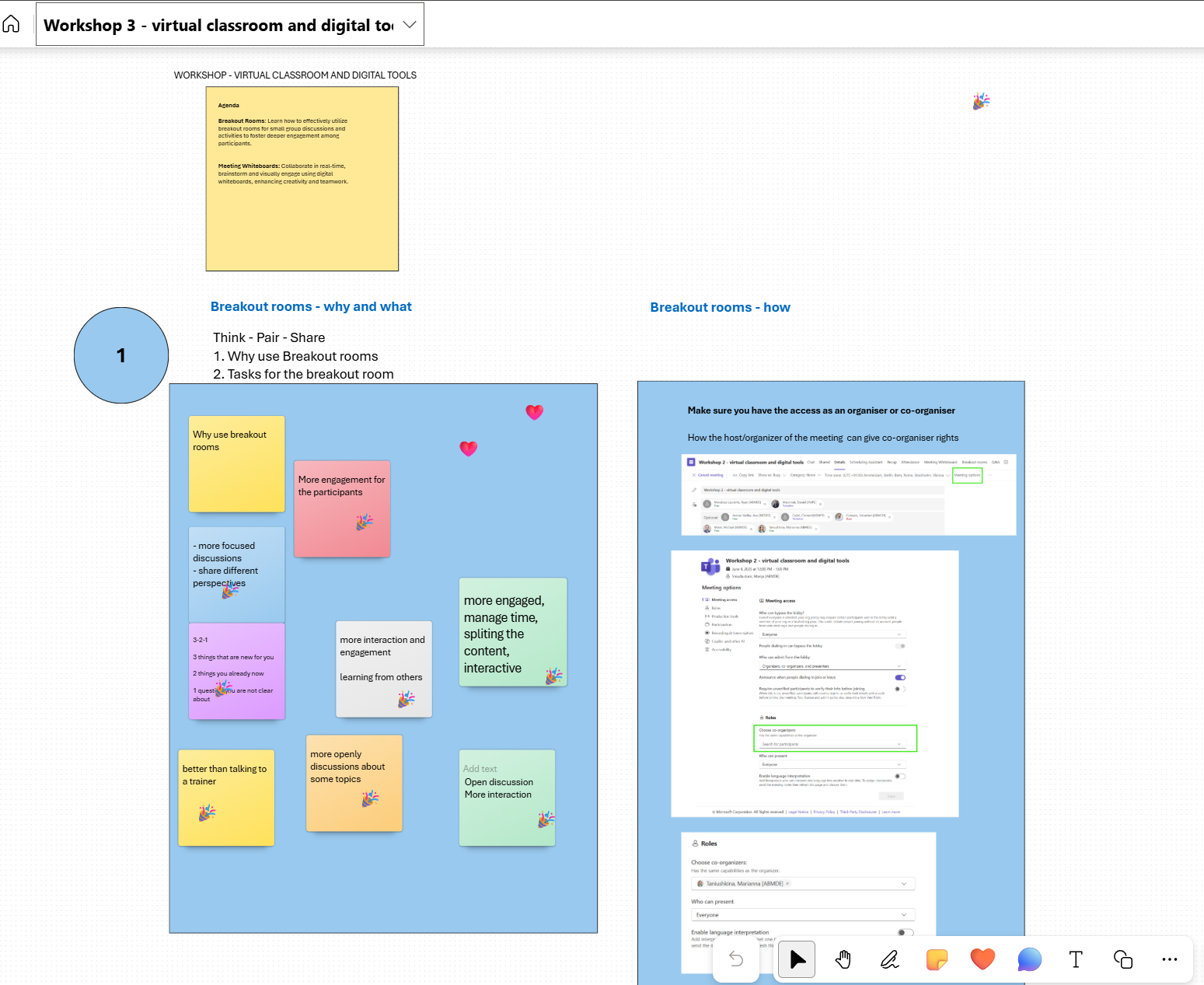
We spent most of our time working with Microsoft Teams breakout rooms and digital whiteboards. We looked at how to split people into small groups quickly so they actually have to talk to each other, and how to use whiteboards so everyone can collaborate visually in real time.
Topic 4: On-Site Training Strategies
This is my absolute favorite topic because we get to combine learning strategies with real-world engagement techniques.
We focused heavily on two big ideas: cognitive strategies (how the brain processes and remembers information) and social learning strategies (how people learn by interacting with others). Instead of just talking about these as dry theories, we practiced how to introduce them in training by actually applying them during our session:
Think-Pair-Share: The trainers got a clinical scenario from one of the presentation decks and had to think through a solution alone, discuss it with a partner, and then share it with the room. This uses both individual thinking and social discussion to lock in understanding.
The 3-2-1 Technique: At the end of a block, everyone wrote down 3 key takeaways, 2 practical applications, and 1 remaining question. This actually became our absolute favorite technique. In every workshop or training session after this one, whenever I was about to invite participants to actively practice something, the trainers would immediately ask if we were doing the 3-2-1.
Generating Questions: Instead of asking "Any questions?", the trainers wrote down their own quiz questions about the product features to test each other, turning a standard review into a social game and discussed how they could implement this when teaching other topics from the program.
Peer Teaching: The trainers split into small groups and had to teach a specific clinical workflow back to the rest of the room. We discussed why teaching others improves learning and how the participants might benefit from this activity.
Topic 5: Communication & Presentation Skills
In this session, we looked at how we deliver information, focusing on two main types of communication: what we see and what we hear. We broke down how small changes in our words, voice, and body language can completely change how confident and trustworthy we seem to a room full of learners.
To improve what we hear, we practiced using specific phrasing prompts to sound more authoritative and confident. Instead of using hesitant language, we practiced shifting our phrasing to research-backed alternatives:
I think...", vs "The research shows..."
"I believe this works...", vs "Based on the data, we know that..."
To improve what we see, we focused on how physical posture projects confidence. We looked at how standing tall, holding our ground, and avoiding nervous pacing makes a crowd trust us instantly.
We wrapped up by taking some text-heavy clinical slides and practicing presenting them using these new verbal and physical techniques, forcing ourselves away from just reading words off a screen.
Topic 6: Effective Questioning Techniques
In this final session, we tackled one of the most undervalued tools a trainer has: asking questions. Too many trainers rely on the classic, lazy habit of ending a section by asking, "Are there any questions?" which almost always leads to total silence. Instead, we focused on how to use intentional, strategic questions to force learners to think and engage.
We worked on three specific types of questions to completely change how we check for understanding:
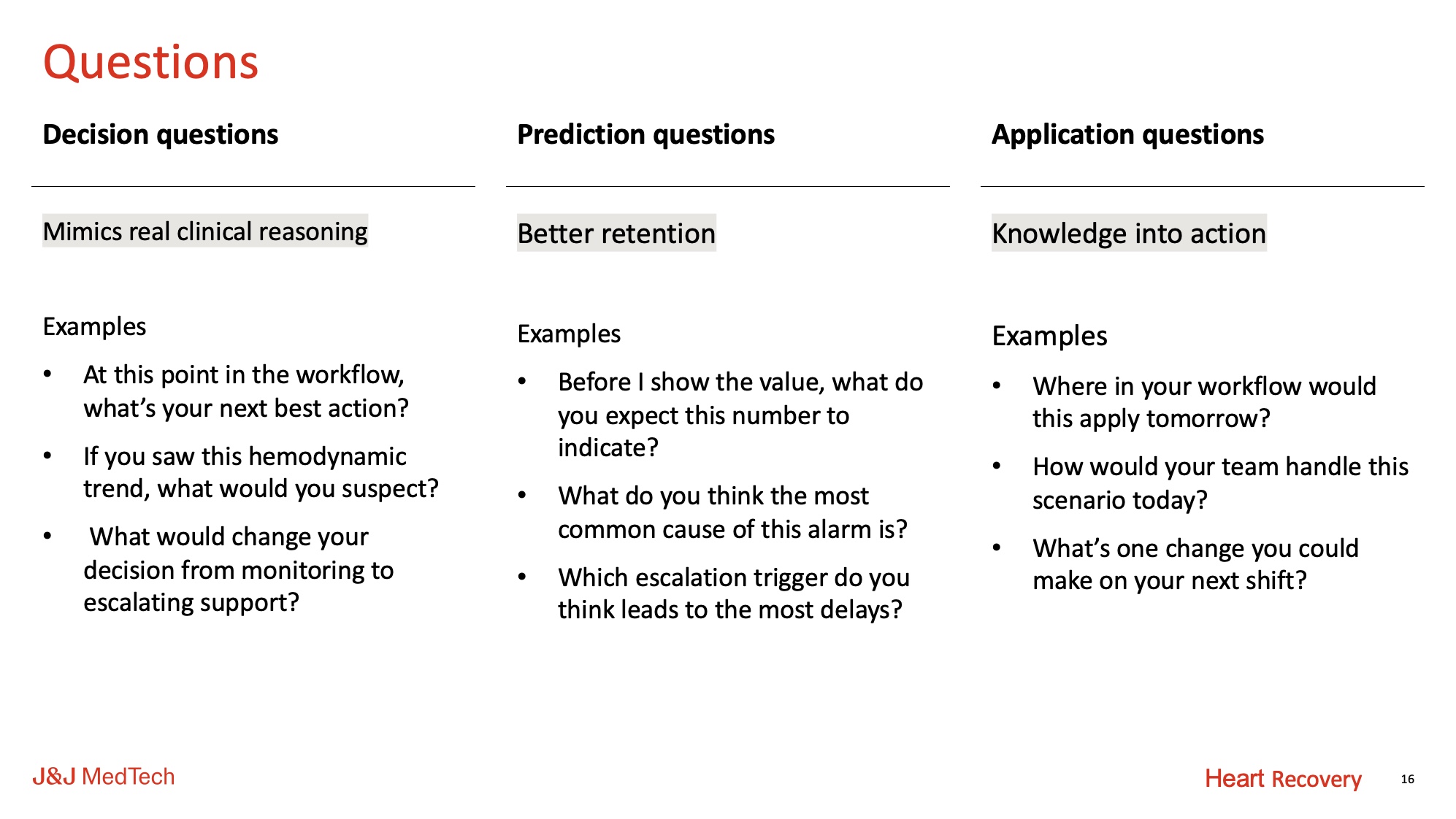
I chose these three specific types of questions as they match our trainees' needs; as clinical consultants, they don't just memorize facts - this approach matches their natural problem-solving mindset and bridges the gap between technical theory and real-world hospital workflows.
Topic 7: Assessment and Evaluation Techniques
In this final session, we explored various assessment techniques as an alternative to explicit questions about facts, focusing on how to integrate them smoothly throughout a training session. The big breakthrough here was realizing that we didn't need to invent entirely new tests; instead, we looked at how most of the engagement techniques we explored in our previous sessions could be transformed into a powerful assessment tool. By shifting our perspective, we learned how to gauge progress naturally without making the clinical consultants feel like they were being formally tested.
Topic 8: Practical Application & Capstone Presentations
In this final topic, everything we learned came together in a high-stakes, practical challenge. The trainers selected one of the specific clinical or product topics they will cover with their next cohort of participants and had to present it live to the group, intentionally applying the core strategies from this entire Train-the-Trainer program.
We weren't just looking for a standard presentation; we were looking for a total transformation of how they deliver content.
Reflections
This was one of the most rewarding Train-the-Trainer programs I have ever facilitated, largely because of the trainers' incredible willingness to grow beyond their roles as SMEs and master the art of training.
It was an amazing exchange of ideas and experiences from start to finish. Empowering other educators is my ultimate passion, and watching this group embrace active, social learning strategies to respect their audience's expertise is exactly why I love this work.