The Future of Higher Education - Where We Are

Introduction
Ten years ago, I wrote and defended a 324-page dissertation with zero AI tools. Today, I use various AI chatbots to reply to a WhatsApp message to my neighbour in German. This shift in how we approach and complete daily tasks is also visible in education and has been giving educators at all levels a headache.
In my new role in higher education, working closely with professors, deans, and instructional designers, two topics constantly pop up: AI and the future of education.
While these conversations are not new, they still cause insecurity, questions, and often resistance. But the tool isn't the problem—how we use it is. (Yes, this sentence has an em dash. No, AI didn't put it here). The real issue is that we are putting old teaching methods and pedagogies on new devices, calling it "educational revolution," "innovation," and "progress." Many universities still reward knowledge reproduction like memorising facts, summarising existing literature, and writing standard essays to prove a student can recall information. We just give them new tools to do it faster or even outsource the whole task.
To figure out how we move forward, we first need an assessment of where we are. This is the first post in a series exploring AI and the future of education, with a focus on current challenges.
What the Data Tells Us
To understand why higher education feels stuck, we have to look at the numbers, and Digital Education Council’s Global Survey (1) provides some interesting insights. This survey was conducted in 2024 and gathered 3839 responses across 16 countries, from bachelor, masters, and doctoral students in multiple fields of study. It offers a diverse range of student viewpoints on AI in education. The results show that in 2024, 86% of university students regularly used generative AI for their studies.
Two years after this study, in 2026, a HEPI survey (2) found that 95% of students use AI in at least one way and 94% say they use generative AI to help with assessed work.
Obviously, the question is no longer if or how many students use AI. It is how they use it.
And HEPI survey provides some answers.
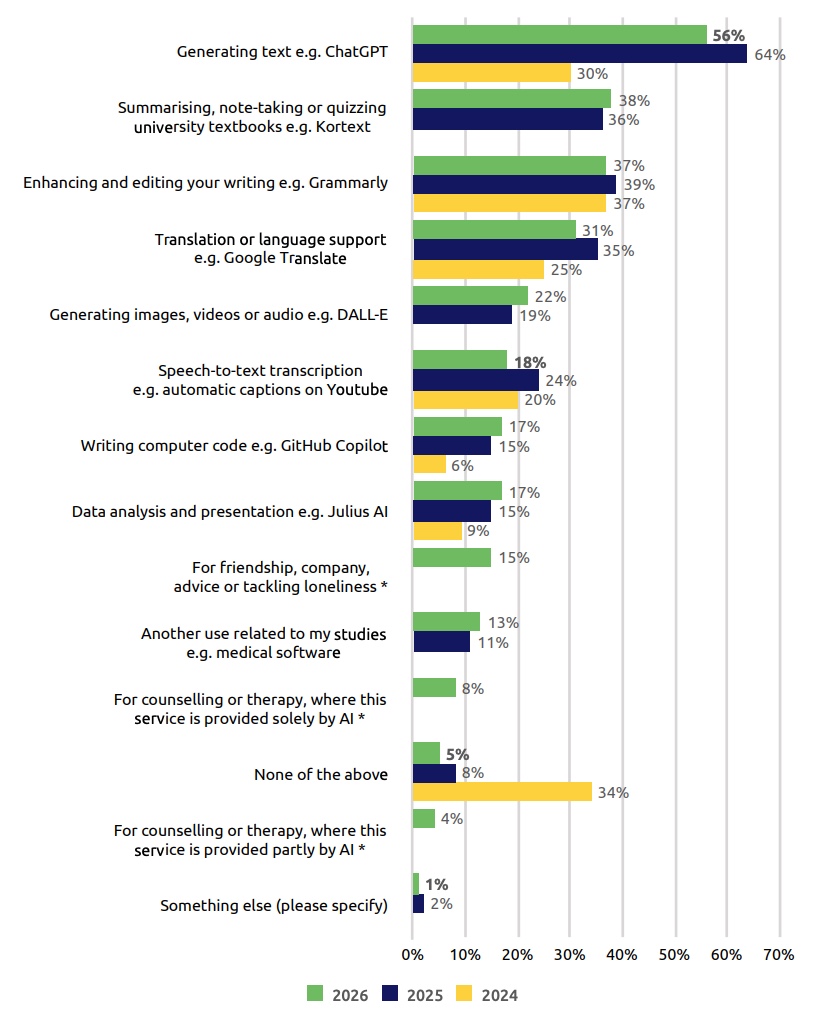
Generating text remains the most popular use of AI. Using AI to summarise, take notes, or quiz textbooks is the second most popular use of AI, followed by enhancing or editing writing using tools. This means that students are skipping the decoding and storing steps of the learning process. And those who recognised that AI has negatively impacted their learning experience say (2):
- My grades have dropped because AI is mitigating my ability to think critically.
- It encourages you to think less.
- It is making us all lazy.
- I feel like I’m not getting the full experience due to AI.
- I think it’s making it too easy.
- It has made me less likely to do independent research.
- I’m not using my brain at all.
To successfully learn with AI, students need to develop other skills, and this is why higher education seems to be stuck:
- Despite their high rates of AI usage, 1 in 2 students do not feel AI-ready
- 58% reported that they do not feel that they have sufficient AI knowledge and skills
- 48% do not feel adequately prepared for an AI-enabled workplace.
Old Methods on New Devices
In my student days, we would go through the lectures by copying text displayed via an overhead projector or, with more tech-savvy lecturers, PowerPoint presentations. That was 20 years ago (yes, I'm that old). Two years ago, I saw lectures where students did the same. But instead of an overhead projector, lecturers used a smart board. Instead of pen and paper, students followed the presentation on their iPads and used Copilot to summarise the content. In both old and recent lectures, knowledge checks during lectures and the final exams were the same. The difference was that recently, the university "revolutionised" learning and students were given free access to Copilot, and they could submit their assignments online via iPads provided by the university.
Education has almost always rewarded knowledge reproduction: memorising facts, summarising existing literature, and writing standard essays that prove a student can recall information.
Data shows that teaching and assessment frameworks have largely remained frozen in the pre-AI era. And it's not because people aren't paying attention. AI is pretty much the only topic being discussed in professional and social circles. So yes, leaders are awake and alarmed. But wakefulness is not the same as movement, and alarm is not the same as action. Gamby and colleagues (3) explain that:
"The speed and scope of change, visible across all sectors of society, can trigger a kind of institutional paralysis that sets in when change moves too quickly and too widely to be managed incrementally. "Deer in the headlights" may be too strong a metaphor, but "deer suddenly alarmed and not knowing which direction to run" may be close. Point solutions and patchwork approaches might be suitable for improving the current ways of doing things, but they are not adequate for a paradigm shift. As a sector, higher education needs to move faster and plan bigger."
iPads, smart boards, free access to Copilot and ChatGPT, and AI detection software are all just tools and devices. So why don't common teaching and assessment methods work with these tools? Because when students use them simply to reproduce knowledge, like summarising texts or generating essays in seconds, they skip the key steps in the learning process itself. Unless we help students develop new skills and test how they think, analyse, and reflect, we will stay stuck with teaching and evaluation methods built for a world that no longer exists.
The Policy and Clarity
Another challenge defining where we are right now is the lack of institutional clarity. Some universities encourage students to use AI during their studies, but then require them to sign a formal integrity declaration stating they have not used and will not use any AI tools for their exams. In one lecture hall, AI use is welcomed and integrated into collaborative brainstorming. In the next classroom down the hall, AI is strictly prohibited under threat of academic penalty.
This unpredictability makes students feel insecure. And those who felt a lack of support or resistance to AI by their institution said (2):
- All we’ve been told is not to use it.
- I haven’t really learnt how to use AI effectively so that I won’t be discredited. I am mostly afraid to use it.
- Simply banning it and not understanding how most students use it or providing resources on AI literacy is more likely to lead to poor and inappropriate use of AI in an assessed context.
- It’s still all very vague and up on the air if / when it can be used and why. It seems to be discouraged without the recognition that it will form an integral part of our working lives.
- [There is] not a lot of education / clear outlining of the institution’s stance on AI, especially considering I am in the technology department.
- They dance around the subject. It’s not banned but not advised, it’s academic misconduct if you use it but lecturers tell us they use it. Very mixed messages.
- They have not adequately considered the differences in the application of AI in different disciplines, leading to a one-size-fits-all policy that limits our learning.
- My institution hasn’t given a clear policy on AI use but they say it is academic misconduct but there are also posters around campus encouraging its use so it is confusing – I can’t tell whether I’m ok to use it or not.
Looking Ahead
So, where do we actually stand? Based on the conversations I’ve had with lecturers, deans, and colleagues, plus ongoing research and broader discussions across the sector, the picture is clear. We’re stuck in a middle ground. Students are running ahead with new tools, while our whole educational setup is still built for a completely different era. The era of 20 years ago, when I was in those classrooms.
If universities want to move forward, we have to start changing how we teach and assess.
In the next post of this series, we’ll look at where we could go. Flipped classrooms, problem-based learning, and collaborative projects are some of the topics we'll dive into and explore if they are the answer to the question: what's the future of higher education?
Read more in:
(1) Digital Education Council. (2024). Global AI student survey 2024: What students want. https://www.digitaleducationcouncil.com/newsroom/what-students-want-key-results-from-dec-global-ai-student-survey-2024
(2) Stephenson, R., & Armstrong, C. (2026). Student generative AI survey 2026 (HEPI Report No. 199). Higher Education Policy Institute. https://www.hepi.ac.uk/wp-content/uploads/2026/03/HEPI-Report-199-Gen-AI-Survey-2026.pdf
(3) Gamby, T., Kil, D., Koblic, R., LeBlanc, P., Moldoveanu, M., & Siemens, G. (2026, June). The current state of play: AI in higher education and the road ahead. EDUCAUSE Review. https://er.educause.edu/articles/2026/6/the-current-state-of-play-ai-in-higher-education-and-the-road-ahead


