The Future of Education - The "Future Skill" University
Introduction
The future of education. This sounds so absolute. And it feels like we urgently have to decide what it will become. But why the feeling of urgency? Education has always changed. Just think of milestones like the printing press, or how computers replaced traditional paper files, and how educational systems had to adapt when the internet introduced global digital libraries and instant communication. Not to mention the protests against introducing calculators into classrooms, or the debates that followed when Learning Management Systems (LMS) and tools like Google Classroom arrived, allowing students to store files, submit assignments, and track grades from any device. And now, AI has moved into the mainstream of student and faculty life. Technology is everywhere, and we are asking ourselves again: what is the future of education?
The future of education is obviously not a new topic of discussion. However, the exponential pace of technological and economic change is now disrupting the centuries-old traditional, lecture-based model from both inside and outside.
Now, we are questioning the core of education: knowledge. What is the know what and know how? Are they still relevant?
Over time, the definition of knowledge has shifted from static facts stored in books to a collaborative network of ideas used to solve real-world problems. Today, simply memorising information is no longer enough because information changes too quickly.
This is why it feels like we urgently have to answer the questions about where education could go.
This is the second post in the series about the future of education. While the first post, "Where we are," focused on current challenges and explained why higher education feels so stuck, this post shifts perspective to offer insights into one scenario for the future of education.
Where We Could Go?
Before you continue reading, think about how you imagine teaching and learning at a university in 10 years.
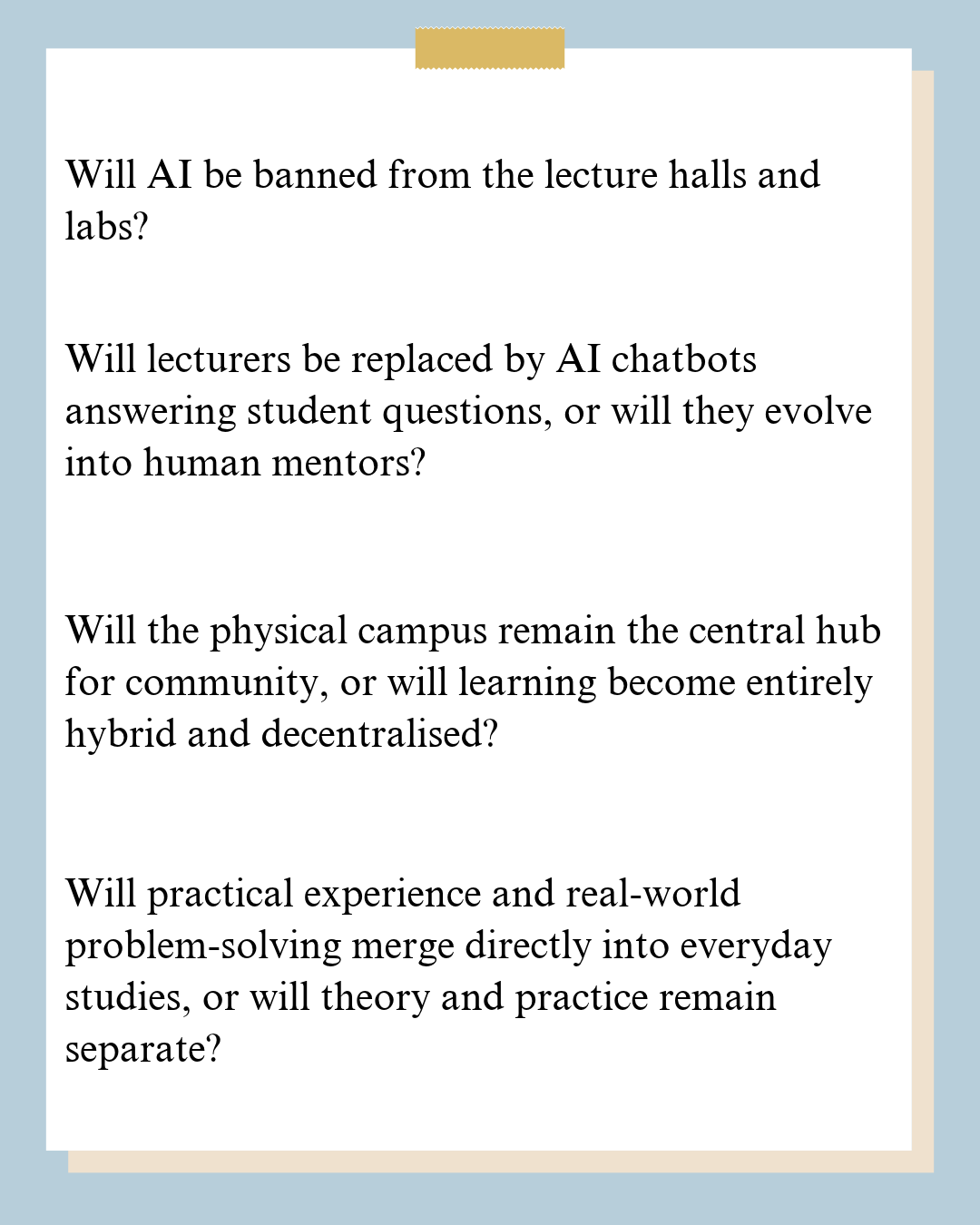
The NextSkills project (developed alongside research at institutions like DHBW Karlsruhe) provides possible answers to these questions. It outlines four distinct scenarios for the future of higher education. These scenarios describe how universities could evolve to meet future competence and learning demands:
- The "future skill" university
- The "networked" university
- The "my-university" scenario
- The lifelong higher learning scenario
In this article, we'll focus on the first scenario.
The "Future Skill" University
Core Focus: Moving away from a traditional model centred purely on knowledge acquisition.
Description: Higher education is organised primarily around developing students' "future skills", such as complex problem-solving, dealing with uncertainty, and cultivating a deep sense of responsibility. It goes beyond fixed curricula designed for predetermined professions.
Let's have a look at the future skills. What exactly do European labour markets require, and how can we empower students to cultivate these skills?
Obviously, simply possessing knowledge is no longer enough. Decades ago, information was scarce and locked away in select books, making those who memorised it invaluable to companies, and equipping students with that knowledge was the primary goal of education. Today, information is available everywhere instantly, meaning the labour market demands a different set of capabilities.
According to large-scale empirical findings from the European Centre for the Development of Vocational Training (Cedefop), the European labour markets require a balanced mix of fundamental and intermediate digital literacy, alongside vital cognitive and human-centric capabilities like critical problem-solving, continuous learning agility, and strong social-interpersonal skills.
Digital literacy skills
While 87% of European workers use computer devices, most jobs require only basic to moderate digital skills (web browsing, emails, word processing, spreadsheets). Only a minority engage with advanced digital technologies like coding or AI algorithms.
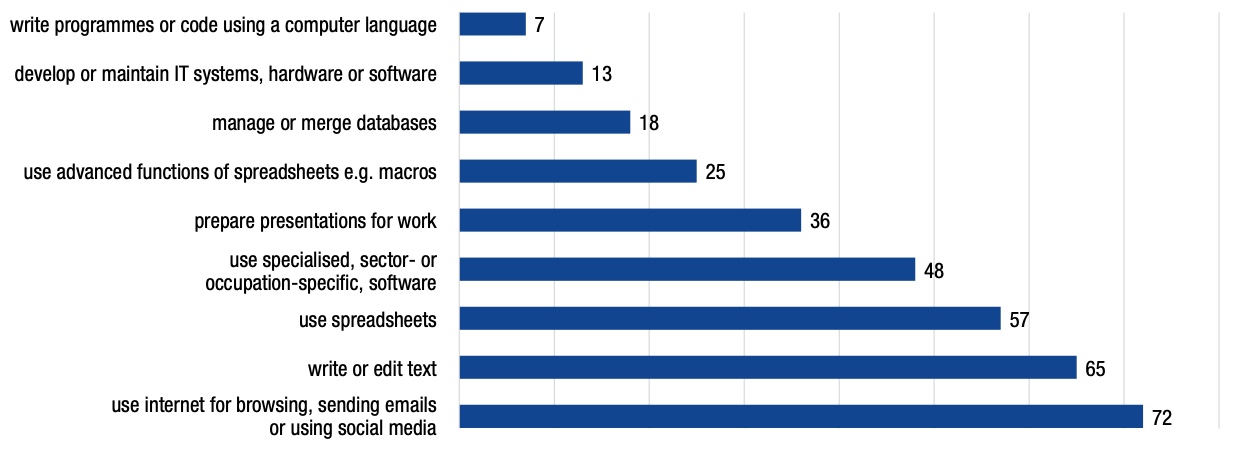
Despite modest (digital) skill demands in EU+ jobs, there is still learning potential: six in 10 adults need to further develop their knowledge and skills to do their job better, and more than half need to improve their digital skills.
How can higher education institutions help close this gap?
Insights from practice: At the university of applied sciences where I taught psychology, every student was given an iPad and free access to Copilot. And then, close to the end of the semester, a student asked if she could present her work as a poster. Creating PowerPoint presentations was difficult for her, and it would take too much time to create one. A whole semester had passed, and I had no idea she struggled with basic tasks like creating and editing presentations. And this is the gap we have to address.
Providing infrastructure like loaner laptops, iPads, stable connectivity, and subsidised tech access is a good step forward. But institutions should focus on helping students build digital skills and confidence, not just device ownership.
Think about my student: she studied at a university deeply invested in AI learning solutions and digitalisation, and struggled for a whole semester before acknowledging she didn't feel comfortable editing PowerPoint presentations. A few targeted approaches could have caught this much sooner.
Provide foundational digital onboarding: Offer low-stakes, non-credit bridge courses at the start of a program or career transition. These should cover basic computer navigation, cloud storage, and essential office tools for learners who have never regularly used them.
Example: Set up the "Sandbox" Lab, a non-graded computer lab during the first two weeks of the semester where students can practice formatting documents, uploading files, or adjusting slide layouts with a student assistant on hand.
Create a stigma-free, supportive environment: Because vulnerable groups often face anxiety or fear of embarrassment in digital or AI-heavy settings, universities can build trust using small peer groups, multi-format guidance (text, video, and audio), and repeatable, slower-paced instructions.
Example: Provide searchable "Explain Like I'm Five" Resource Hubs. These could be bite-sized video libraries that break down software tasks into 60-second clips, allowing students to re-watch instructions as many times as needed at their own pace.
Shift from reactive to proactive intervention: Rather than waiting for students to identify their own gaps and ask for help, institutions can use data-driven tracking to reach out early, offering tailored support and personalised feedback paths that respect individual learning needs.
- Example: Send a brief, low-pressure pulse survey at the end of week three asking specifically about comfort levels with assigned software and learning tools, automatically routing resources to those who report friction.
To meet the complete market demands outlined by Cedefop, institutions must look beyond technical readiness to equally foster human-centric capabilities.
Human-centric skills
In his book Future Skills – Future Learning, Future Higher Education, Ehlers (1) states that:
...problem-solving capacities, the innovation skills and competences, creativity must be enhanced in order to shape the diverse reality of evolving organisations. It is also about mindfulness, emotional intelligence, a design mindset and systems thinking, networked thinking, changing perspectives, taking the perspective of the other in order to advance. It is stories like these that characterize what students have to develop as competence, as capacity to act and shape the future.
Kovács (2) compares human and AI performance, noting that both have limitations and that AI can occasionally surpass human capabilities. From a philosophical standpoint, he argues that artificial intelligence can never replicate genuine human effort, authentic lived experience, or the capacity to set and pursue independent life goals. Previous research by Deming (3) explains the growing economic demand for social skills. He highlights the human "theory of mind"—our innate ability to step into another person's shoes, interpret emotional cues, and respond fluidly. Because computers and algorithms cannot easily quantify or automate these interpersonal nuances, they struggle immensely with such tasks.
So, we have problem-solving capacities, emotional intelligence, the ability to change perspectives, authentic lived experience, capacity to set and pursue life goals, interpreting emotional cues and responding to them as some of the human-centric skills and one question left.
How can higher education institutions help students cultivate human-centric skills?
Insights from practice: A few days ago, I observed a lecture in programming. As part of the practical section, students had to fill out a memory layout sketch representing how variables are stored in computer memory. Instead of just giving students the task that can easily be solved with AI, the prof set it up as a collaborative exercise. With pen and paper. Then she walked around the groups, helping them manage their dynamics, negotiate differences, and change perspectives. She smiled and encouraged them, showing the value of genuine human effort. This is something no AI can do.
To help cultivate human-centric skills, professors must first embody them.
Think back to your favourite teacher or lecturer—what made them truly special? Was it merely the knowledge they possessed, or how they used it to inspire? Was it how they dictated the facts they knew, or their ability to motivate and encourage, the visible effort they poured into their lectures, and the infectious energy they brought to the room? Maybe it was how they shared their personal experiences and motivated you to set and pursue your life goals.
Were all professors like this?
To prepare students for the future, higher education institutions must first invest in their own people. By offering workshops, seminars, and ongoing opportunities to share best practices, we can help educators continuously develop the future skills they are asked to teach.
But professional growth doesn't end with faculty workshops. Here is what educators can immediately apply to everyday teaching practices.
Integrate social and emotional learning (SEL) into your syllabus: You can move past a purely technical focus in your course by weaving SEL principles into your teaching, helping students build empathy and emotional intelligence.
Examples: In an engineering ethics course, you can have students role-play stakeholder discussions to understand how technology impacts vulnerable communities. In business programs, you can design peer-review sessions that incorporate structured feedback on communication and emotional awareness rather than focusing solely on financial outcomes.
Design collaborative group work and task coordination: You can structure your coursework around collaborative, multi-disciplinary projects that teach students how to manage group dynamics and negotiate differences.
Examples: You can group engineering, design, and marketing students together to launch a simulated product from scratch, requiring them to bridge technical execution with human strategy and division of labour. Similarly, you can have public policy students work in task forces to draft legislation, resolving conflicting priorities through negotiation.
Prioritise active, discussion-based, and experiential learning: To prevent students from relying entirely on AI for thinking and memorisation, you can shift your assessment style toward interactive and experiential methods that foster critical and systems thinking.
Examples: Instead of assigning traditional multiple-choice tasks, you can have students participate in live case-study debates where they must defend contrasting viewpoints in real time. You can also use simulation games where student teams must collectively solve a crisis scenario that changes dynamically based on their decisions.
Foster human-centred mentorship and psychological safety: As automated tools handle more of your routine administrative and grading tasks, you can intentionally reallocate that time toward deeper student mentorship to encourage creativity, psychological safety, and resilience.
Examples: You can offer regular one-on-one "failure resilience" check-ins, guiding students through creative blocks or project setbacks. You can also establish small-group advising circles during office hours to mentor students through long-term academic challenges and personal growth.
By integrating social and emotional learning, designing collaborative teamwork, prioritising active experiences, and fostering human-centred mentorship, individual lecturers can actively bridge the gap between technical automation and essential human capabilities.
Conclusion
Preparing students for the future doesn't mean choosing between digital literacy and human-centric skills; it means weaving them together. By meeting learners where they are with patience, proactive support, and a stigma-free environment, we can close the gaps that often hide in plain sight. And by investing in educators who inspire, mentor, and model genuine emotional intelligence, we create spaces where true learning happens.
Read more in:
(1) Ehlers, U.-D. (2020). Future skills: The future of learning and higher education. Springer. https://doi.org/10.1007/978-3-658-29297-3
(2) Kovács, L. (2023). 15 Was wird die KI nie können? Leistungsgrenzen Künstlicher Intelligenz in Zukunft. In L. Kovács (Ed.), Künstliche Intelligenz und menschliche Gesellschaft (pp. 215-232). Berlin, Boston: De Gruyter Oldenbourg. https://doi.org/10.1515/9783111034706-015
(3) Deming, D. J. (2016). The growing importance of social skills in the labor market (Working Paper No. 21473). National Bureau of Economic Research.